For physiotherapists and orthopaedists

You see the child now and then.
They should exercise daily.

Paidoria does not replace you. It gives the child a reason and the appetite to exercise tomorrow as well.

What the child exercises is up to you. Paidoria only wraps it in a story the child wants to watch to the end.

You or the parent choose the exercises Runs in a browser One exercise setting for every story and game
A physiotherapist in a practice room with an exercise mat

Paidoria is not a medical device. It does not diagnose, it does not assess health status and it does not replace professional care. It is a children’s app that motivates children to move regularly.

No guesswork

What Paidoria does
and what it does not

What Paidoria does

  • It gives the child a reason to exercise regularly — the exercise is built right into the story.
  • You choose the exercises — the parent ticks them in the library on your recommendation.
  • The parent sets the length of each exercise, from 10 to 60 seconds.
  • The selection applies across the whole app — in the stories and in the mini-games.

What Paidoria does not do

  • It does not diagnose and does not assess health status.
  • It does not check whether an exercise is performed correctly.
  • It does not replace professional care.
  • It does not count repetitions — the exercises run on time.
The mechanics

How it
works

The child follows the story and becomes part of it — they help the hero past the obstacles by exercising.

1You choose the exercises

The parent ticks them in the library and sets how long each one should last.

2Paidoria wraps them in a story

The exercise is built right into the plot — a timed exercise follows every scene.

3The child exercises

Because they want to know how it ends. Not because someone reminded them.

Squat with a jump
Running on the spot
Jumping jack

Three of the more than 70 exercises in the library — and more keep coming. Each one is created under the supervision of experienced physiotherapists, and the animation faithfully copies the movement of a real person. You can see the whole list in the app when choosing.

Settings

What can
be set

  • The choice of specific exercises from the library.
  • The length of each exercise, from 10 to 60 seconds.
  • The “no jumping” and “no floor exercises” limits.
  • Pause is always available — the child can stop the exercise at any time.
  • The selection applies everywhere — in the stories and in the mini-games.
In practice

How the parent
signs up

Three steps you have to step into no more than once.

1You tell them what to tick

Which exercises the child should have enabled and how long each one should last.

2The parent sets up an account

Setting it up takes a few minutes. Paidoria runs in a browser, nothing is installed.

3The child exercises at home

The exercise is part of the story, so the child opens it on their own — the next day too.

For a family the first 7 days are free, then €9.99 a month for the first child and €4.99 for each additional one.

How an orthopaedist sees Paidoria

MUDr. Vladimír Popelka orthopaedist Statement for Paidoria · Translated from Slovak

A specialist can recommend suitable content, and Paidoria can help with what is often the hardest part of exercising at home – keeping the child interested and the exercise regular.

The statement covers both what the author values in Paidoria and what to watch out for when exercising.

Read the full statement Hide the statement 2 min

As an orthopaedist, I consider regular movement to be one of the most important parts of a child’s healthy development. Today, however, it is not enough just to tell children that they should move more. They need an activity that captures their interest and that they will want to come back to. That is exactly why I was drawn to the concept of Paidoria, which combines fairy-tale stories with movement and learning. The child becomes part of the plot and the exercise gains a concrete purpose – it helps the heroes overcome obstacles and moves the story forward.

I see the greatest value in motivation. Even a well-designed exercise is of limited use if the child does not want to do it or does not stick with it. For parents, it can be challenging to persuade a child to exercise every day. A playful form can make this situation easier. If a child sees movement as part of an adventure, they may take part in it more willingly and gradually develop a positive relationship with regular activity.

From the perspective of the musculoskeletal system, I appreciate the possibility of fitting exercise into an ordinary day, even in shorter blocks. Well-chosen movement breaks have their place at home and at school, where children spend a lot of time sitting. They can be an opportunity to practise coordination, balance, mobility and body awareness. What is important here is that the exercises suit the child’s age and abilities and that the child performs them correctly. I consider the quality of movement more important than the number of repetitions or the speed at which a task is completed.

I also view positively the possibility of tailoring the choice of exercises to a specific child. Two children of the same age need not have the same fitness, motor skills or health-related capabilities. Here I see room for cooperation between the parent and an orthopaedist or physiotherapist. A specialist can recommend suitable content, and Paidoria can help with what is often the hardest part of exercising at home – keeping the child interested and the exercise regular.

When using it, I would recommend that parents pay attention to how the child exercises. Especially with younger children, it is advisable for an adult to be present, to make sure there is enough space and to help with performing the movement. Exercise should be appropriate and should not cause pain. In the case of pain, limping or a known orthopaedic diagnosis, the choice of activities needs to be the subject of individual consultation.

I see Paidoria as a meaningful addition to everyday physical activity. It can bring variety to activities at home and at school and help reach children who are less willing to join in ordinary exercise. In the case of specific diagnoses, such as scoliosis or foot deformities, however, a specialist examination and individually managed treatment must remain the basis. The concept of the app alone is not enough to assess its therapeutic effect.

What I value most about this project is the effort to bring movement closer to children in a way they understand. If it helps them get moving regularly, experience the joy of their own movement and carry this relationship over into outdoor play or sport, I consider that, from my perspective as an orthopaedist, a valuable contribution.

MUDr. Vladimír Popelka, orthopaedist

Paidoria is not a medical device and does not replace professional care.
Materials for your practice

Write to us and we will send you materials you can hand to a parent — a short explanation of what Paidoria is and the steps for setting the exercises up.

Request the materials

A professional opinion and an award

What others have said
about the project

Both come from the time when the project was called Vyskilluj — it is the same team and the same app under a new name.

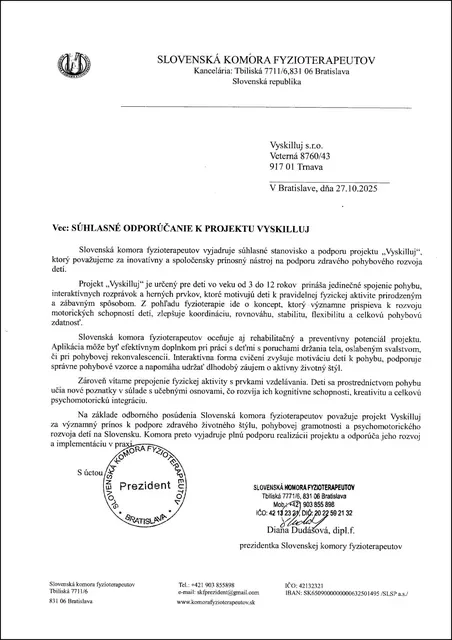
Slovak Chamber of Physiotherapists

Favourable opinion of the Slovak Chamber of Physiotherapists

The Chamber issued a favourable opinion on the project and expressed its support.

Favourable opinion of the Slovak Chamber of Physiotherapists — scanned letter
JCI Slovakia and the Entrepreneurs Association of Slovakia

Young Innovative Entrepreneur 2025

An award for innovation and social responsibility, presented within the competition by BMW. It was collected by the founder of the project.

The founder collecting the Young Innovative Entrepreneur 2025 award

In the media

The older articles were published while the project was still called Vyskilluj. Click through to the original text.

Frequently asked

What you ask
most often

Does the child need a camera?

No. Exercises run on a timer — with a spoken prompt and a countdown. Counting repetitions with the camera is something we are still working on.

Do you collect diagnoses or health data?

No, none at all. At home we store only the child name and the exercise settings. With school homework we store a name or nickname, the class and the result — nothing more.

Is Paidoria a medical device?

No. Paidoria does not diagnose, does not assess and does not replace professional care. It is a children app that gives a child a reason to move regularly.

Does the app check whether an exercise is done correctly?

No. Exercises run on a timer, not on a number of repetitions, and the app does not evaluate how they are performed. That stays with you and with the parent.

Will I be told whether the child exercised at home?

No. Paidoria sends you no reports. The only feedback is what you see at the appointment — the child shows you their Buddy and the stories they have finished.

What does it cost a family I recommend it to?

The first 7 days are free, then €9.99 a month for the first child and €4.99 for each additional one.

Paidoria is not a medical device. It does not diagnose, it does not assess health status and it does not replace professional care. It is a children’s app that motivates children to move regularly.

Would you like to recommend it to parents?

Write to us about the children you work with and what you would need. We will get back to you and agree on the next step.

We need essential cookies to run the site. Statistical and marketing cookies help us understand where our visitors come from — we only switch those on with your consent. Your choice also applies to measuring sign-up and payment in the Paidoria app (app.paidoria.com).

Cookie policy · Privacy policy

You can change your choice at any time in the site footer.